Monday, December 22, 2014

Frequently Asked Questions Page

I am reviving my internet footprint.


Here is a picture of my desk in the command center at the Holometer. I was studying the control system that runs our interferometers.

I created a frequently asked questions page which you can see above.

I created a twitter account. 

I updated my website.

enjoy.

Friday, April 26, 2013

Unbalanced Matter

Physicists are all about symmetry, simplicity and explaining everything in the universe. When one of these things don't hang together then it leaves a lot of scientists quite puzzled.


A puzzling observation is that there is an asymmetric property of matter - we have more matter than anti-matter in the universe. Why is that? Physicists frame this problem as CP-symmetry is broken. CP-symmetry, is the product of two symmetries: C for charge conjugation, which transforms a particle into its antiparticle, and P for parity, which creates the mirror image of a physical system [1]. Out of the four fundamental forces of physics, the weak force does not seem to obey this property. This interesting insight gave scientists the right clue on where the asymmetry may lie. Dr. Chien-Shiung Wu in the 1950s found the first experimental evidence for P-symmetry breaking in weak force reactions [2]. Her landmark work opened the doors for the current crusade to  verify signatures of CP violation.

You won't find CP violation signatures on your table-top lab bench. Rather, you need a gigantic particle accelerator to smash highly energetic particles together to observe this phenomenon. Scientists working on the large hadron collider (LHC) have found signatures of this apparent symmetry breaking. Read here for more information.

When did this unbalance of matter and anti-matter begin? Well, that answer is still trying to be experimentally verified. Current cosmologists and particle physicists believe that this asymmetry occurred within the first second after the Big-Bang. Cosmologists hunt for signatures in the cosmic microwave while particle physicists do so with particle accelerators

The mystery is still out there and we are on our way to find out why.


Here was my walk through the Wikipedia library : 
[1] : CP violation
[2] : Chien-Shiung Wu
[3] : Parity

Wednesday, April 3, 2013

Creativity


"Brittany, you are too creative to be a scientist." This statement was uttered by a friend of mine months and months ago. He said it to me a few times while we were hanging out during his visit. At first, I laughed it off. People tend to think I am an artist rather than a scientist. I can see how people may get that impression from my fluid lifestyle and colorful articles of clothing. I can understand how people have this impression since I do not fit the stereotypical science mold.

However, after hearing this statement repeated to me it began to resonate in my head. I began questioning this statement. Why are scientists seen as drones? Robots who are incapable of feelings, interacting with humans, smiling, doing anything but locking themselves in a windowless room solving the mysteries of the universe. Obviously, with the robot's high intellect they are essentially devoid of any creative fiber. Where did this picture come from and why is it proliferated?

I have to say that is the absolute furthest thing from the truth. Scientists are amongst the most creative creatures on earth. Scientists and artists follow a very similar lifestyle. They dedicate their lives to learning technical skills to create their picture. This effort is done to communicate the abstraction in their mind to the rest of the world. Scientists and artist can find themselves completely enthralled in their craft. They share similarities when they become so absorbed in a particular idea that they may forget to eat or sleep. That is just part of the creative process.

Contrary to scientist lore - we are incredibly social. The whole system of science caters to both the social and anti-social aspects of each human. Scientists have to work on articulating their ideas so people can understand them. They most do this in the form of spoken and written word by writing papers, giving presentations, and engaging others in informal discussions. An important aspect of the scientific balancing act is working alone to make sure you understand your work. However, that's not the only thing scientists do.


Scientists are creative. 

Scientists are social.

Scientists are fun.


image credit : sungazing.com + addicted2success.com


Sunday, March 24, 2013

Science is a story


Through my adventures in physics, it took me a long time to realize this - science is a story. This story is written by very curious people on a pursuit to understand a question. The story of science is communicated through conversations at bars, personal off-line letters between friends, scribbles on pieces of paper, academic debates between opposing parties, and new connections made when teaching a non-specialist. We are writing a novel of curious pursuits and we contribute to the scientific body of knowledge through learning new technical skills, sharing work in journals, presenting a talk and going to conferences. I hope my colleagues and the public don't lose sight of this beautiful fact.

We are writing a story. Together.


image credit : dailykos.com, letswritetogether.wikispaces.com

Wednesday, September 12, 2012

The Motion of the Universe


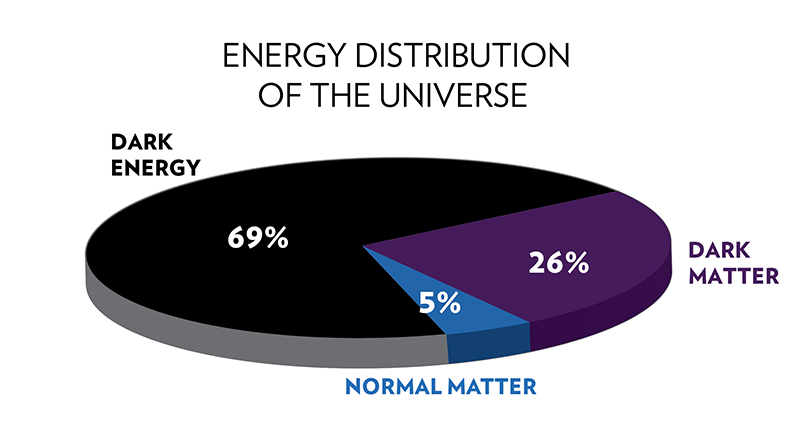
The ingredients of the universe are baryonic matter, dark matter, dark energy, radiation and neutrinos. We focus on the two main ingredients which is matter (both baryonic and dark) and dark energy.

The Big Bang gives the universe an initial kick to begin expanding. How do the different ingredients of the universe affect this expansion? What we are looking for is the equation of motion of the universe. The Friedmann equation is the equation that describes this. It tells us how the universe's expansion is affect by varying amounts of matter and dark energy.

Matter wants to oppose the expansion of the universe due to gravity. In the same way that a ball thrown in the air on earth wants to oppose the throw and come back due to the earth's gravitational pull. Dark energy aids in the expansion anad at some point in the universe leads to an accelerated expansion. It would be as if the thrown ball would take off in the direction of the throw and never return to the earth.


The Friedmann equation tells us how the universe will expand given a certain amount of matter and dark energy. Will the universe collapse back on itself because of all the matter in the universe? Will the universe expand forever and ever? We gain an important clue about the universe by studying how much it has expanded from the Big Bang until now. We learn how much matter and how much dark energy are in the universe. We can also make predictions about the fate of the universe given these proportions.

This motion of the universe is the large scale behavior. In this scenario, you treat everything as a homogeneous substance. The next natural extension to that question is surrounding the fine details of that homogeneous substance. How does matter behave on smaller scales that lead to the galaxies and stars that we see today? These are the inhomogeneities of the universe that we observe today. How and when did this come about in the history of the universe?

This in an interesting question that the 'structure formation' community studies in detail.


image credits : science progress website, chandra xray observatory

Wednesday, September 5, 2012

2 quotes

"You are symphony of matter waves"
 -- Fabienne Bastien

"This equation is beautiful in its simplicity yet astounding in it's complexity"
-- Brittany Kamai + Fabienne Bastien

Thursday, June 14, 2012

Why be a scientist?


It is probably the coolest thing that you could spend your life doing.


How does it start? It starts with exactly that. A question. Your inquisitive mind conjures up a question that you are very interested in learning the answer to. This is the same inquisitive mind that you were born with. Thus, the pursuit to find an answer begins.

What do you do first? Ask your the question to your friends, your parents, your teachers, your dog, anyone and anything within earshot. Each answer that you hear might not resonate well with you. You want something better. You read books, papers, Wikipedia, Google,etc. It is still not enough to give you a satisfactory answer. So, your quest starts to develop into a passion to learn more and better equip yourself to answer the question.

As a scientist, this is what drives you. Asking questions. Learning more. Asking more questions. Even if you learned the answer to the original question, you don't stay there. You dedicate your life to the fascinating art of solving puzzles. It's much like solving a Rubik's cube. The task of having each side of a cube all one color sounds deceiving simple. At first, it looks quite possible. However after your initial attempts, you seem be in a similar state with which you started. You try and try and try again but seem to run yourself in circles. There are points where you seem to be on the right track but you are stuck at a dead end. What do you do? Ask a better trained Rubik's cube solver for some tips. Once you have trained yourself in a variety of cube solving skills, you set yourself up for being able to solve the entire puzzle. Then the day comes and you finally configure the puzzle to this simple state. Now solving this puzzle seems so easy. The perfectly decoded cube sits there curiously looking you in the face. You and the cube are satisfied. For an instant.

In this curious pursuit to answer the questions, you may leave in your wake technological advances that may benefit society. There will be times when there is no technique in the world that can help you solve a problem along the way. You need to be creative and resourceful to find a solution with the tools that you have. Maybe this is the first time someone has ever done it. Maybe this is something that future generations can continue to use and improve upon. Maybe. However, you were doing it since you were interested in finding the answer to the question.


And this epic journey started simply by asking a question.


image credit : familysonlinemagazine

Monday, May 14, 2012

Intellectual Debates


If you give the same question to a physicist, a philosopher, a biologist and a historian and they will all tackle the problem very differently. This is simply due to the fact that each field has a very different toolset that is used for working on problems. I think it is very important to recognize this difference when you begin an intellectual debate between different people from very different backgrounds. It is very important to stay clear about what question has been asked. Most specifically how each point being argued fits into your strategy to answer the question.

I think a cause for intellectual debates to turn into arguments is when both parties fail to recognize that they are not arguing the same question. I also think arguments develop when both parties think their way to think is "better". There is no "better" way of thinking about a problem. There is no "better" toolset to work with. Each approach is unique and quite interesting. So, it is important to listen to a person with an alternative view. You may actually learn something new.


image credit : warren carl stone

Wednesday, May 9, 2012

Crack Not


image credit : alphacoder

If you are in academia, you would have heard the term "crackpot" in reference to some seemingly wacky idea. The term is used rather dismissively towards the individuals coming up with some idea. "Oh that's a crackpot theory."  But did we ever stop to think what that really is? Did we ever stop to questions what these individuals may be attempting to do? In my opinion, I think that the "crackpots" are actually pursuing a creative attempt to push the boundaries of knowledge given the limited amount of information available to them.

When jumping into a particular field, you spend months and years trying to understand the language of the field. You learn the jargon and start to understand a common school of thought. You do this for a very long time, before one tries to push the boundaries of their field and forward knowledge. In my opinion, what this system inadvertently does is make the people on the "inside" dismiss those who are on the "outside". We stick up our noses at anyone who misuses our jargon and tries to extend an idea in a way that isn't quite right. We stick up our noses at the someone trying to make connections when it may not be a viable one.

However, what gets left out of many books is the reality of discovery. Most discoveries were little "accidents". Once this accident happened it sparked curiosity upon the person who made the mistake. They questioned why this happened and sought after finding a reason how this could happen. Upon further examination, they were able to validate that something might not be wrong with what they did. So what is the next thing they do? Share it with the world.

If what they found was correct, it would take a while for the world to accept it. It takes a while for paradigms to shift. It takes a while for a school of thought to accept a tangential off shoot of the mainstream. And what exactly is that off shoot called colloquially? "Going out on a limb." And if you would like to say it dismissively, you could call it a "crackpot theory".

My proposal would be to listen more and try to understand what attempts are being made to extend the current ideas. It is possible that they might be able to see something you can't and make connections that you wouldn't be able to see. So, listen. You might actually learn something.

Tuesday, May 1, 2012

Hmm what is this weird noise source?


Here is the deal. At your job in the 60's at Bell labs, your boss gives you a new device that you need to understand everything about. The device is the new Holmdel Horn Antenna which is a detector used to measure a very faint signal that bounces off echo ballons. What you do for the next few years is "characterize your detector", just a fancy way of saying that you study the way the detector works in excruciating detail.

You begin by turning on your detector and studying how much power actually hits your detector. Next, you ask the question where does this power come from? You run a series of tests to understand the signal on your detector. You find that sometimes the power readings are too high or too low and you ask yourself why. You find that some are due to the rising and the setting of the sun. You find that some power fluctuations are due to how hot the actual detector is. You find teeny power fluctuations due to the changes in the seasons throughout the year. And this is what you spend your time doing hunting for noise sources. Power fluctuations due to anything other than the signal you are looking for are considered noise sources.

This was the exact job of Arno Penzias and Robert Wilson. They spent their time in the early 1960's running tests on their detector to identify noise sources. This detector operates in the radio regime of the electromagnetic spectrum (more on that later). That means their device is sensitive to long wavelength light.

The mystery arises when Penzias and Wilson can not identify why their detector is reading too much power. They go back to their calculations over and over again and can not figure out WHY this is there. They are stumped. They think and think and think about where this extra power could be coming from. They figured out it wasn't the earth, it wasn't the sun, they did research to find if it was in our galaxy and didn't think so. So what do you do?

Call a friend and ask for help.

Wilson & Penzias
Bernie Burke


Penzias and Wilson got and the phone with a friend of theirs at MIT named Bernie Burke. They asked him if he knew of any extra-galactic radio sources that may be contributing to their signal. Burke replied by saying that he read a pre-print article by Jim Peebles discussing that there may be left over radiation from the early universe. This could potentially be what you are seeing. Why don't you give Robert Dicke from Princeton a call? He has made a prediction about where we should see this signal and is gathering a team to go detect it.

Robert Dicke
Penzias and Wilson got excited because this could be a very important discovery. At the time, there was a HUGE debate in the scientific community about whether the universe was expanding or staying still. There was no experimental evidence to tell you one way or another.


Following their friend's advice, Penzias gave Dicke a call and asked about what he thought of their findings. Dicke sent over Peebles' article for a read. After a few phone exchanges, Robert Dicke, Jim Peebles and Dave Wilkinson made their way over from Princeton to the detector in New Jersey.


Jim Peebles

After visiting the site, both groups spent some time working out whether or not this detection was THE detection they were looking for. They decided to publish separate papers in the same Physical Revue Letters edition. Peebles, Dicke and Wilkinson's paper proposed that if the universe had a very hot beginning and expanded over time, then left over light will have cooled into the radio regime where we could detect it. Penzias and Wilson's paper discussed their apparatus and the methods along with their measurement. They reference Peebles, Dicke and Wilkinson as having the proper interpretation of their result.


Dave Wilkinson

So let's just stop for a minute and recap. You went to work to characterize a detector that is looking for faint radio signal bouncing off echo balloons. During the process of trying to understand all of your noise sources, you run into a puzzle you can't solve. You ask a friend for their opinion on what it could be. They happened to read a paper that offers a suggestion on what how to interpret what you see. And by you picking up the phone to confirm this, you establish a relationship with some of the greatest scientists of all time. Before you know it, you and your co-worker have just stumbled across arguably the most important experimental evidence for cosmology. Your detection is how we have confirmation that we live in a universe that began from a hot big bang.

That is pretty cool.


image credits : wikipedia

Friday, April 27, 2012

just how epic is the CMB measurement?


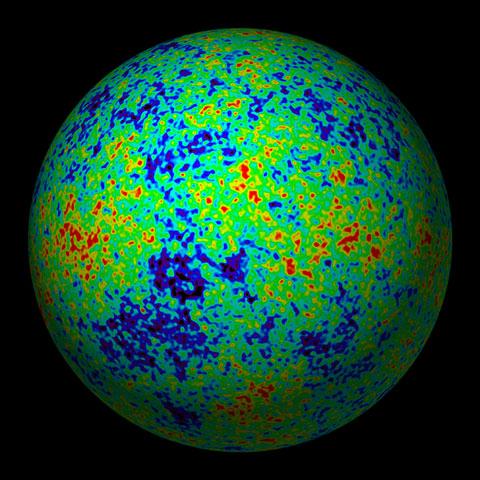
We have all seen this picture. We know what it is called. We can say where it comes from. We know the discovery story.

But I asked the question: "Just what is the big deal with the cosmic microwave background?" 

Furthermore, How did this serendipitous story of discovery lead to the most significant cosmological experiment to date? I personally felt that there were some critical steps left out of the story that did not allow me to appreciate just how important this measurement is and how the process of discovery *actually* happened. I am going to spend a few posts talking about it. Why? Because it is cool.

The CMB in a nutshell : 
  • CMB = Cosmic Microwave Background
  • The cosmic microwave background is a measurement that the temperature of the entire sky is 2.73 Kelvin = -270.3 Celsius = -454.54 Fahrenheit
  • The picture above is a map of the very,very tiny temperature fluctuations in the sky as measured by the WMAP instrument. The colors follow our human intuition of how colors related to different temperatures.* The warmer and cooler colors correspond to warmer and cooler temperatures fluctuations. 
  • In the very early universe, photons of light could not escape the opaque environment. When the universe expanded and cooled, the environment became transparent enough that photons of light were able to escape. These photons from the very early universe IS the radiation we measure in the microwave regime. (Don't worry, I will provide a much longer explanation of this later!)
  • The discovery of the CMB was made by two scientists working at Bell Labs in NJ. The discovery of the excess radiation was made by Penzias and Wilson. The interpretation of what this excess radiation actually is was provided by Peebles, Dicke, and Wilkinson. 
  • What parameters did the CMB give us? (not a complete list)
    • Age of the universe
    • Amount of baryons in the universe (all the stuff we are made of and can see!)
    • Amount of dark matter
    • Amount of dark energy
    • The geometry of the universe
    • Man that is a lot! What else do you need? More on these parameters too!

I am going to spend a few posts talking about the discovery story, where the CMB photons come from, how to interpret data, and ALL of the cosmological parameters that we get out of the CMB.

Stay tuned!


*This statement of our "human intuition of how colors relate to temperature" is not a good physical way of categorizing a color to temperature relationship. In reality, bluer colors are actually much much hotter than the redder colors. Looking at a flame can confirm this for you. What color is the center of the flame? Is the center of the flame hotter or cooler than the outside of the flame?

Thursday, January 26, 2012

a measurement


" The team measured the accelerated expansion of the universe using observations of distant supernovae."

Whenever I hear statements like that I am in complete awe that these scientists can make such profound claims and conclusions. I puzzle how one could "simply" look at the data in a particular plot and conclude that our universe has an accelerated expansion. I think to myself that they must be incredibly intelligent people who are capable of just seeing this. I hope one day that I can be like them. I would take good quality data and it would be completely obvious to me that the deep underlying meanings of physics will just pop out at me.

You know what? There is a huge, huge problem with that. Its not the stand alone data that leads you to these conclusions. It is the synergistic relationship between data and theory that allow scientists to make a claim. There is no possible way that by simply looking at how photons arrived on your detector you would be able to conclude this. You need to see if a theory can fit your data points. And this is what you search for. You are looking to find a connection between a theory and the data that you have collected.

Only when you find that the predictions from you theory match your data THEN you can make a real life scientific claim. You need the theories AND you need the data. They are simply nothing without each other. 

And that is what a true measurement is.

Monday, January 23, 2012

holometer in the news

I work on this really cool experiment called the Holometer. I will definitely write a blog post soon describing many different interesting aspects of the project. Lots of people around the world have been coming and investigating what we have been doing. The latest landed an  article in Scientific American. I think that is pretty cool.

Scientific American February 2012 : Is Space Digital?