Physicists are all about symmetry, simplicity and explaining everything in the universe. When one of these things don't hang together then it leaves a lot of scientists quite puzzled.
A puzzling observation is that there is an asymmetric property of matter - we have more matter than anti-matter in the universe. Why is that? Physicists frame this problem as CP-symmetry is broken. CP-symmetry, is the product of two symmetries: C for charge conjugation, which transforms a particle into its antiparticle, and P for parity, which creates the mirror image of a physical system [1]. Out of the four fundamental forces of physics, the weak force does not seem to obey this property. This interesting insight gave scientists the right clue on where the asymmetry may lie. Dr. Chien-Shiung Wu in the 1950s found the first experimental evidence for P-symmetry breaking in weak force reactions [2]. Her landmark work opened the doors for the current crusade to verify signatures of CP violation.
You won't find CP violation signatures on your table-top lab bench. Rather, you need a gigantic particle accelerator to smash highly energetic particles together to observe this phenomenon. Scientists working on the large hadron collider (LHC) have found signatures of this apparent symmetry breaking. Read here for more information.
When did this unbalance of matter and anti-matter begin? Well, that
answer is still trying to be experimentally verified. Current
cosmologists and particle physicists believe that this asymmetry
occurred within the first second after the Big-Bang. Cosmologists hunt for signatures in the cosmic microwave while particle physicists do so with particle accelerators
The mystery is still out there and we are on our way to find out why.
Here was my walk through the Wikipedia library :
[1] : CP violation
[2] : Chien-Shiung Wu
[3] : Parity
Showing posts with label how cool is that?. Show all posts
Friday, April 26, 2013
Thursday, June 14, 2012
Why be a scientist?
It is probably the coolest thing that you could spend your life doing.
How does it start? It starts with exactly that. A question. Your inquisitive mind conjures up a question that you are very interested in learning the answer to. This is the same inquisitive mind that you were born with. Thus, the pursuit to find an answer begins.
What do you do first? Ask your the question to your friends, your parents, your teachers, your dog, anyone and anything within earshot. Each answer that you hear might not resonate well with you. You want something better. You read books, papers, Wikipedia, Google,etc. It is still not enough to give you a satisfactory answer. So, your quest starts to develop into a passion to learn more and better equip yourself to answer the question.
As a scientist, this is what drives you. Asking questions. Learning more. Asking more questions. Even if you learned the answer to the original question, you don't stay there. You dedicate your life to the fascinating art of solving puzzles. It's much like solving a Rubik's cube. The task of having each side of a cube all one color sounds deceiving simple. At first, it looks quite possible. However after your initial attempts, you seem be in a similar state with which you started. You try and try and try again but seem to run yourself in circles. There are points where you seem to be on the right track but you are stuck at a dead end. What do you do? Ask a better trained Rubik's cube solver for some tips. Once you have trained yourself in a variety of cube solving skills, you set yourself up for being able to solve the entire puzzle. Then the day comes and you finally configure the puzzle to this simple state. Now solving this puzzle seems so easy. The perfectly decoded cube sits there curiously looking you in the face. You and the cube are satisfied. For an instant.
In this curious pursuit to answer the questions, you may leave in your wake technological advances that may benefit society. There will be times when there is no technique in the world that can help you solve a problem along the way. You need to be creative and resourceful to find a solution with the tools that you have. Maybe this is the first time someone has ever done it. Maybe this is something that future generations can continue to use and improve upon. Maybe. However, you were doing it since you were interested in finding the answer to the question.
And this epic journey started simply by asking a question.
image credit : familysonlinemagazine
Monday, May 14, 2012
Intellectual Debates
If you give the same question to a physicist, a philosopher, a biologist and a historian and they will all tackle the problem very differently. This is simply due to the fact that each field has a very different toolset that is used for working on problems. I think it is very important to recognize this difference when you begin an intellectual debate between different people from very different backgrounds. It is very important to stay clear about what question has been asked. Most specifically how each point being argued fits into your strategy to answer the question.
I think a cause for intellectual debates to turn into arguments is when both parties fail to recognize that they are not arguing the same question. I also think arguments develop when both parties think their way to think is "better". There is no "better" way of thinking about a problem. There is no "better" toolset to work with. Each approach is unique and quite interesting. So, it is important to listen to a person with an alternative view. You may actually learn something new.
image credit : warren carl stone
Friday, April 27, 2012
just how epic is the CMB measurement?
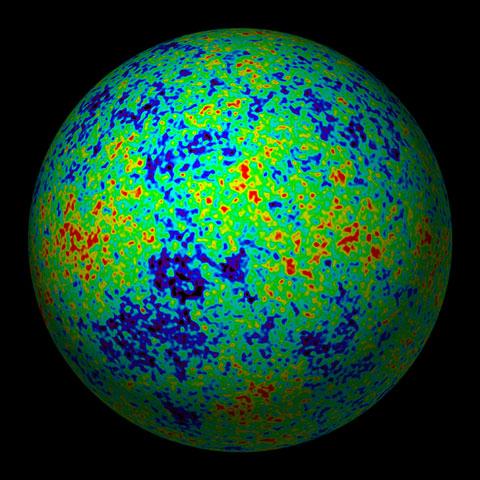
We have all seen this picture. We know what it is called. We can say where it comes from. We know the discovery story.
But I asked the question: "Just what is the big deal with the cosmic microwave background?"
Furthermore, How did this serendipitous story of discovery lead to the most significant cosmological experiment to date? I personally felt that there were some critical steps left out of the story that did not allow me to appreciate just how important this measurement is and how the process of discovery *actually* happened. I am going to spend a few posts talking about it. Why? Because it is cool.
The CMB in a nutshell :
- CMB = Cosmic Microwave Background
- The cosmic microwave background is a measurement that the temperature of the entire sky is 2.73 Kelvin = -270.3 Celsius = -454.54 Fahrenheit
- The picture above is a map of the very,very tiny temperature fluctuations in the sky as measured by the WMAP instrument. The colors follow our human intuition of how colors related to different temperatures.* The warmer and cooler colors correspond to warmer and cooler temperatures fluctuations.
- In the very early universe, photons of light could not escape the opaque environment. When the universe expanded and cooled, the environment became transparent enough that photons of light were able to escape. These photons from the very early universe IS the radiation we measure in the microwave regime. (Don't worry, I will provide a much longer explanation of this later!)
- The discovery of the CMB was made by two scientists working at Bell Labs in NJ. The discovery of the excess radiation was made by Penzias and Wilson. The interpretation of what this excess radiation actually is was provided by Peebles, Dicke, and Wilkinson.
- What parameters did the CMB give us? (not a complete list)
- Age of the universe
- Amount of baryons in the universe (all the stuff we are made of and can see!)
- Amount of dark matter
- Amount of dark energy
- The geometry of the universe
- Man that is a lot! What else do you need? More on these parameters too!
I am going to spend a few posts talking about the discovery story, where the CMB photons come from, how to interpret data, and ALL of the cosmological parameters that we get out of the CMB.
Stay tuned!
*This statement of our "human intuition of how colors relate to temperature" is not a good physical way of categorizing a color to temperature relationship. In reality, bluer colors are actually much much hotter than the redder colors. Looking at a flame can confirm this for you. What color is the center of the flame? Is the center of the flame hotter or cooler than the outside of the flame?
Monday, January 23, 2012
holometer in the news
I work on this really cool experiment called the Holometer. I will definitely write a blog post soon describing many different interesting aspects of the project. Lots of people around the world have been coming and investigating what we have been doing. The latest landed an article in Scientific American. I think that is pretty cool.
Scientific American February 2012 : Is Space Digital?
Subscribe to:
Posts (Atom)